Machines can generate prose that’s pretty convincing, but can they write stories worth reading?

The A.I. question is dividing authors along a thin red line: Can you outsource your writing to large language models?
A.I. adopters say that with the right prompts, an author can train LLMs to produce prose that readers can't tell from the genuine article.
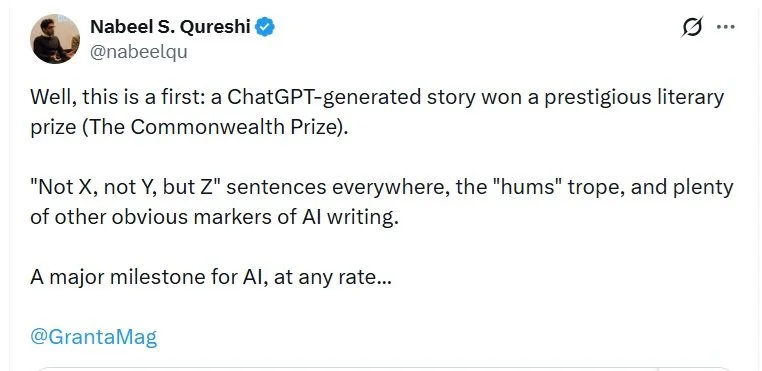
And besides, they insist, the only way to beat A.I. slop farms at the volume game is to use the same tools, only for good.
But is the hype over A.I. writing justified?
Court of Kairos member Rawle Nyanzi and I recently put LLM-generated prose to the test.
Rawle supplied a sample of LLM-generated fiction, and I put it under the knife during an episode of Word Surgery, my live editing stream.
Watch the results for yourself:
The problem of judging A.I. writing
Most arguments over A.I. fixate on whether or not readers can spot machine-generated text.
But picking nits about repetitive phrases and verbal quirks never gets past the surface level.
After more than a decade as an editor, I’ve learned that perfectly cromulent text can hide some of the worst problems. You can have a grammatically correct and vividly descriptive piece of prose that still fails as a story.
Because if you don’t have a clear protagonist with a concrete goal setting out to achieve it against opposition, at best you’ve got atmosphere.
But no story.
That’s not to say human authors never write novels with developmental-level problems. Far from it!
But it is to say that armchair A.I. diagnoses tend to miss the developmental forest for the line-level trees.